Cinematic sound design is not just about making things big. It is about weight, depth, movement, and the sense that a sound belongs in a real space, whether that means a huge braam, a synthetic percussion patch, or something more textural and atmospheric.
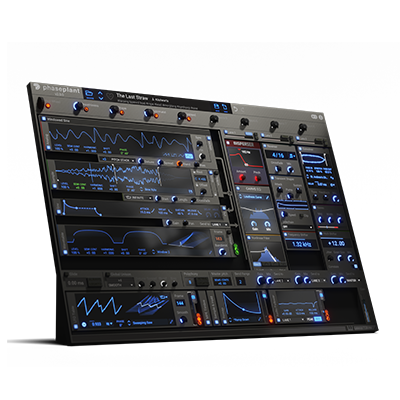
That is one of the reasons Phase Plant works so well for this kind of work. It gives you loads of freedom when building layers and effects chains, but it also makes it easy to turn a patch into something expressive and playable. With smart macro setups, mod wheel control, and all the modulation options, one patch can cover a dramatic range of movement, intensity, and character.
That also makes cinematic sound design a very natural part of Phase Plant's 7th Anniversary.
That balance between big sound and hands-on control comes through clearly in the work of Geoffrey Day, a Phase Plant Power User who co-runs Noise Dept., worked on the soundtrack for Atomic Heart, and helped shape the Oblivion Engine Content Bank.
We put seven questions to Geoffrey Day about cinematic sound design, preset building, and how Phase Plant fits into that workflow.
Q. To start us off, can you introduce yourself and tell our readers a little about your work?
I'm Geoffrey Day and I co-run Noise Dept., a company focused on helping musicians and producers make the heaviest music on the planet by giving them boutique sounds, products, and tools. Besides that, I do soundtrack composing work, most notably for Atomic Heart, and previously I made a bunch of videos on the YouTube channel GeoffPlaysGuitar.
Q. What do you feel defines a "cinematic" sound?
There's a number of things that come to mind, but I think if I had to pick one standout it would be a sense of depth and position in large spaces.
We're used to that classic orchestra sound in movies and games where everything is recorded in a large room, and the level of intensity or intimacy or spaciousness is defined by the mix of microphones and the post-processing. Once you have that mapped in your brain, you can mostly use any selection of instruments in a cinematic way.
In modern cinematic scores, you'll probably hear composers trying out all sorts of electronic elements and extended techniques, but what they all have in common is the glue of a third dimension: those sounds living together in a large shared space.
Q. Which parts of Phase Plant make it especially powerful for cinematic work?
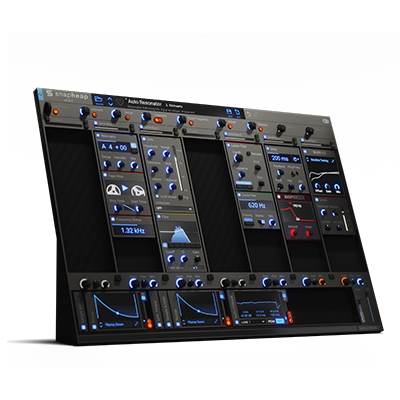
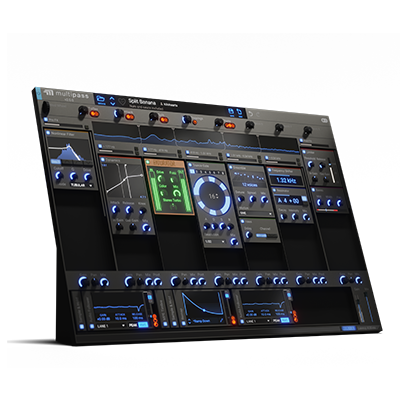
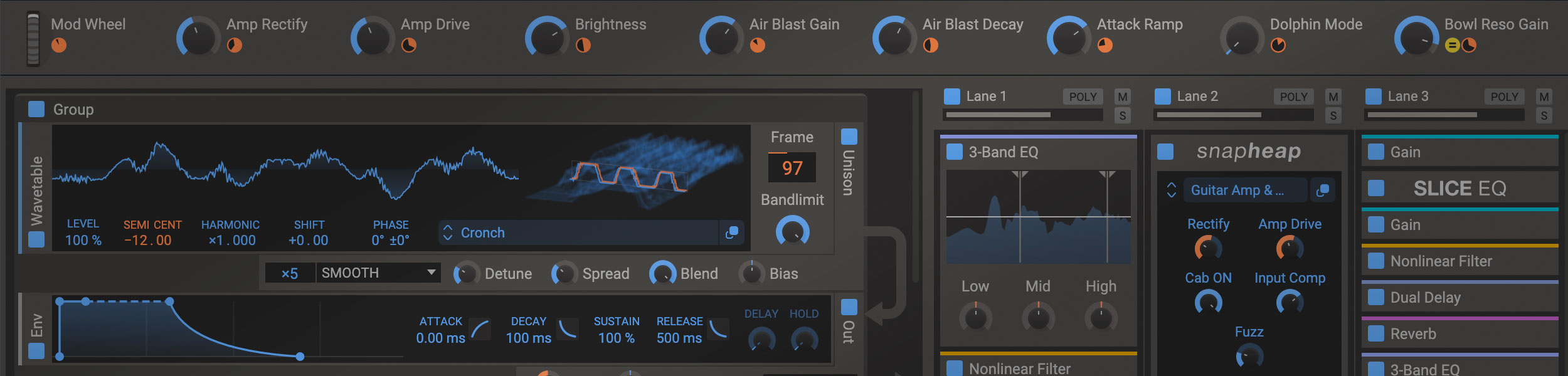
It's easy to call out the Granular and Sample Player generators since they are common things to use when working with recorded material, but I think the most powerful part of Phase Plant is actually its seamless integration with Snap Heap and Multipass.
Since they allow a producer like me to make custom modules out of collections of inserts, I find it invaluable for hammering out the perfect cinematic reverbs, overdrives, and filter effects ahead of time. A runner-up for me is the robust modulation section along the bottom of Phase Plant, which allows me to build hyper-expressive performance experiences for each patch.
Q. Is there one sound in Oblivion Engine that really encapsulates your approach to cinematic sound design?
Hard to pick one, but I'll pick two.
The first is Wake The Titan, which uses a wavetable to provide the consistent main body of the sound with a sample layer that provides the chaotic atonal noisy part. This is a lot like how string instruments sound when you separate a violin or a guitar into their tonal and noise components, and it guided the design choices in that patch.
The second example is Bucket Troop, which I designed to sound as much like a percussion sampler library as possible despite it being fully synthesized. The detailed velocity mapping and the convolution reverb do a ton of heavy lifting to make it sound lifelike.
Q. When you are building a braam in Phase Plant, where do you usually start?
I always start with a super-fast sweeping envelope connected to some pitch value. The goal is to get the start of the braam to punch unnaturally hard.
Unsurprisingly, this is also how you would start if you wanted to make a synthesized kick drum. After getting the start of the braam sounding good, and as long as you can play low notes, the rest of the process is pretty open-ended.
Q. How do you balance deep patch design with making presets that other people can actually use?
My goal for every patch is "no wrong keyboard keys". Does a grand piano have a sweet spot? No, and neither should synth patches.
Expressiveness comes from patch designs which elegantly handle user input and which don't get in the way of someone's intended performance. I lean on envelopes, note mapping, velocity mod, and randomization a lot.
Macro knobs and the mod wheel can be performance-oriented, like vibrato, or tone-oriented, like adding more reverb, but either way they should be clearly understood as one or the other by the user.
I often have to ask myself, "is the patch a two-handed patch (poly keys) or a one-handed-plus-controller patch (lead with mod wheel) or is it meant entirely for being programmed (sequencer/arpeggiator)?" and that guides the designs along.
Q. What is next for Noise Dept.?
Drums. And a bunch of other stuff, but all I can tell you is that the color scheme will be red and black.
Huge thanks to Geoffrey for taking the time to answer our questions and share a bit of how he approaches cinematic sound design in Phase Plant.
If you want to hear more from Geoffrey, check out Noise Dept., his soundtrack work at Geoffrey Day Music, and the GeoffPlaysGuitar channel.
If you want to dig a little deeper, the video below is a preset demo with some extra insight into how Geoffrey approaches this kind of sound.

As part of the anniversary celebration, Phase Plant is $100 off and all Content Banks are 50% off from May 28th to June 12th, so if this feature leaves you wanting to build a few huge cinematic patches of your own, this is a pretty good time to do it.
This article is part of Phase Plant's 7th Anniversary, where we are talking to more Phase Plant Power Users about bass design, FM, MPE, game audio, cinematic work, wavetable design, and generative sound.