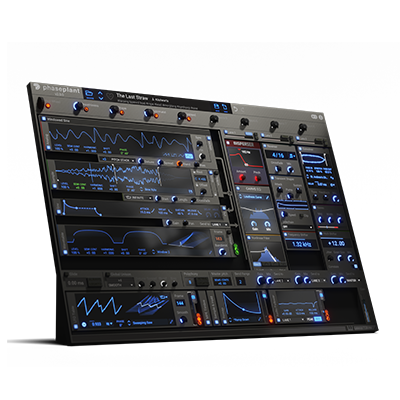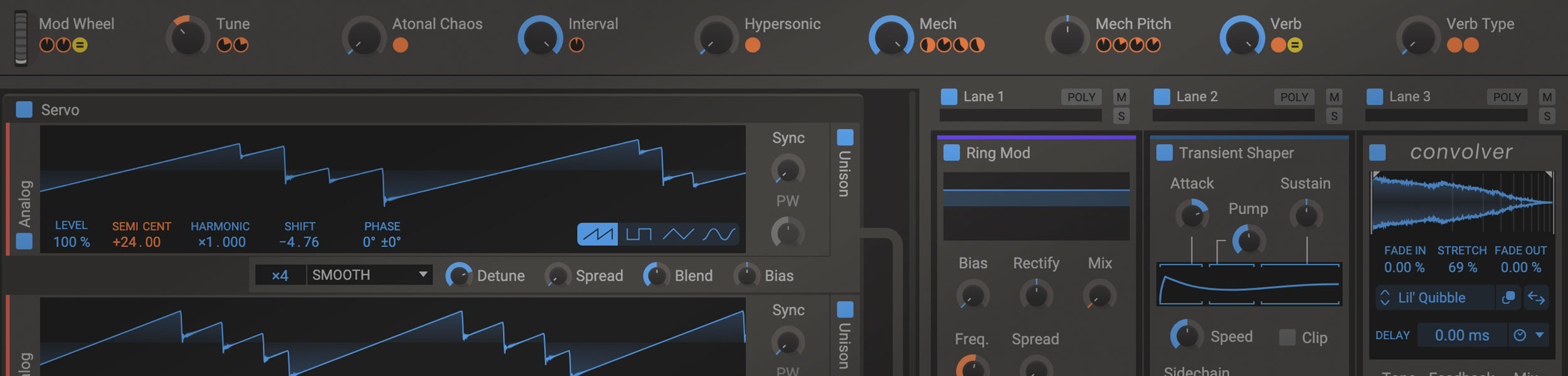
Game audio is one of those areas where Phase Plant feels right at home.
Interactive sound design rewards tools that are flexible, fast, and reusable. You need strong source sounds, but you also need variation, consistency, and workflows that hold up across a lot of assets.
That makes it an easy fit for Phase Plant's 7th Anniversary, and a nice way to show what the instrument can do when speed, control, and variation all matter at once.
Aaron Wolff was our first choice of people to talk to about this. He is a Phase Plant Power User with a background in both synthesis and AAA game audio, and he loves to get into workflow, procedural thinking, and why a synth like Phase Plant is such a valuable tool for professionals like himself.
We asked Aaron seven questions about game audio workflow, procedural sound design, and why Phase Plant fits so naturally into the job.
Q. To start us off, can you introduce yourself and tell our readers a little about your work in game audio?
My name is Aaron Wolff, and I design audio and audio systems for AAA games. I have a background in programming synthesizers.
My path into game audio was sort of from electronic music, through synthesis, to sound effects for games. As a result, I have a passion for elegant proceduralism in all areas, but especially in audio.
Q. What makes a sound design tool genuinely useful for game audio?
I think this answer could be different for different people, but for me, a sound design tool becomes genuinely useful for game audio if it provides a frictionless path to executing an idea.
There is definitely a time for the restrictions of one's tools to aid creativity by breaking someone out of a rut, but I find that quite often, at least in sound effects, when we are meeting a utilitarian need for a sound that goes in conjunction with visuals or an existing game mechanic, there are a finite set of right answers. Once conceived in the mind, they need to be brought into reality as promptly and painlessly as possible.
Q. Why does Phase Plant fit so well into game sound workflows?
Phase Plant looks and feels simple and easy to use, but it is incredibly powerful and flexible.
It's one of the few pieces of software where the more I learn about it, the more I realize there is to learn and experiment with, and that's a great feeling. For me, it sits at an ideal balance of simplicity and power. I think there's so much more that's possible in Phase Plant that no one has even done yet.
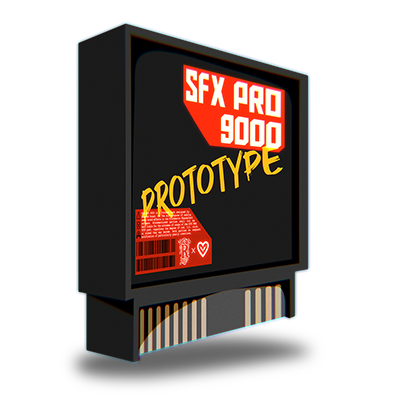
Q. Are there one or two presets in SFX Pro 9000 that you would single out as shining examples of Phase Plant in use for game audio?
For a standard nonlinear game audio workflow where you are ingesting one-shot audio files into Wwise or a game engine, it's super helpful to have a patch that lets you quickly generate infinite variations.
Patches like Tonal Bullet Ricochet Hit or Sword Swish do this, so I would recommend those, or that sort of patch format more generally. They can be tweaked to fit the needs of the user.
For linear designs, personally I've used Tire Skid Simulator in multiple racing cinematics, and found it very useful for getting the skids just right.
Q. What kinds of game sounds do you think Phase Plant is especially good at that people might not expect?
Even though it's known as a hybrid wavetable, subtractive, and FM synth, the way it's set up with its modularity and simplicity makes it pretty effective for setting up some simple physical modeling.
Q. How would you recommend someone new to Phase Plant gets started with it for game audio?
I think making procedural ambiences is a great way to start, because you can get viable results very quickly.
There is no need to analyze frequencies or milliseconds, or make resonance models of anything. You can just throw some random modulators on a few parameters and tweak them to taste. You could use noise or even load audio files into the sampler.
Q. What is your next big project that you can tell us about?
I'm going to try to start making some synthesis sound design tutorials on YouTube!
Huge thanks to Aaron for taking the time to answer our questions and share a bit of his thinking around procedural audio, workflow, and game-ready sound design.
If you want to keep up with what Aaron is doing next, subscribe to his brand new YouTube channel and watch out for updates.
If you want to see Aaron dive further into the synthesis techniques used in the SFX Pro 9000 Content Bank, the video below is for you.

And if you want to try that workflow for yourself, Phase Plant is $100 off and all Content Banks are 50% off from May 28th to June 12th.
This article is part of Phase Plant's 7th Anniversary, where we are talking to more Phase Plant Power Users about bass design, FM, MPE, game audio, cinematic work, wavetable design, and generative sound.