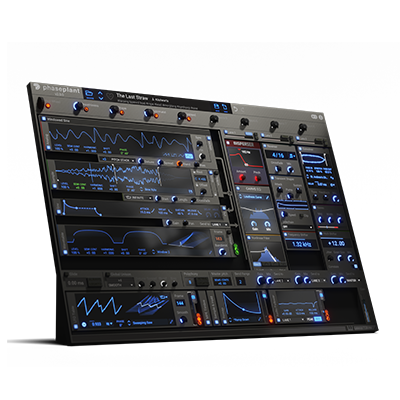
Some Phase Plant patches are built to be played. Others are built to evolve on their own.
That is, to many, one of the most interesting sides of Phase Plant. With the right patching, modulation, and a bit of patience, Phase Plant can produce sounds that feel less like fixed presets and more like living systems with their own behavior.
We first became aware of Amfivolia through his tutorial videos, and he was an obvious person to turn to for questions about this kind of sound design. He is a distinct kind of Phase Plant Power User, and his work draws on ecology, composition, and close listening to build synthetic sound worlds full of movement and interaction, which made him a lovely fit for Phase Plant's 7th Anniversary.
It also says a lot about why Phase Plant works so well for this kind of sound design. It is flexible, quick to experiment with, and deep enough to let one patch open up into something much richer.
We put seven questions to Amfivolia about generative sound design, synthetic ecosystems, and how Phase Plant fits into that process.
Q. To start us off, can you introduce yourself and tell our readers a little about your work?
Hi, I'm Amfi. In general I am a multidisciplinary artist, but my focal projects are usually sound-oriented. Recovering from hearing loss in my youth has left me with a fascination for sound, which has more recently converged with my lifelong captivation by the natural sciences. This takes form in both music compositions inspired by natural systems, as well as ecosystem sound design projects, which I dissect on my YouTube channel.
Q. What would you say is the key to making a soundscape feel alive?
It's a tough question as I'm a pluralist in this regard: I wouldn't select any singular technique as being key.
That said, for a soundscape as a whole, I think focusing on behavioral patterns between sounds instead of obsessing over the quality of individual sounds can lead to more lively results. These patterns could be MIDI-based call and response systems for animals, geophonic sound cycles, and so on. We are good at recognizing patterns, so creating even simple ecologically inspired patterns to recognize is important, in my view.
Q. Why does Phase Plant work so well for this kind of sound design?
When it comes to approaching large-scale sound design projects, I prefer using a synth that is at the intersection of flexibility, capability, and usability, which Phase Plant is to me.
It's flexible because it's semi-modular, and it's capable in that the modules themselves are fairly high-level, which enables me to iterate on ideas quickly. Moreover, Phase Plant allows for audio-rate modulation, which is essential for animal sounds that have modulation rates that fall into the audible spectrum.
And to be honest, I favor having things on just one screen: I find myself switching panels a lot in other synth interfaces, whereas in Phase Plant I don't have to tab around as much.
Q. What synthesis challenges do you encounter when doing natural sound design?
For me, a sound becomes challenging to synthesize when the design process reveals features I didn't initially hear.
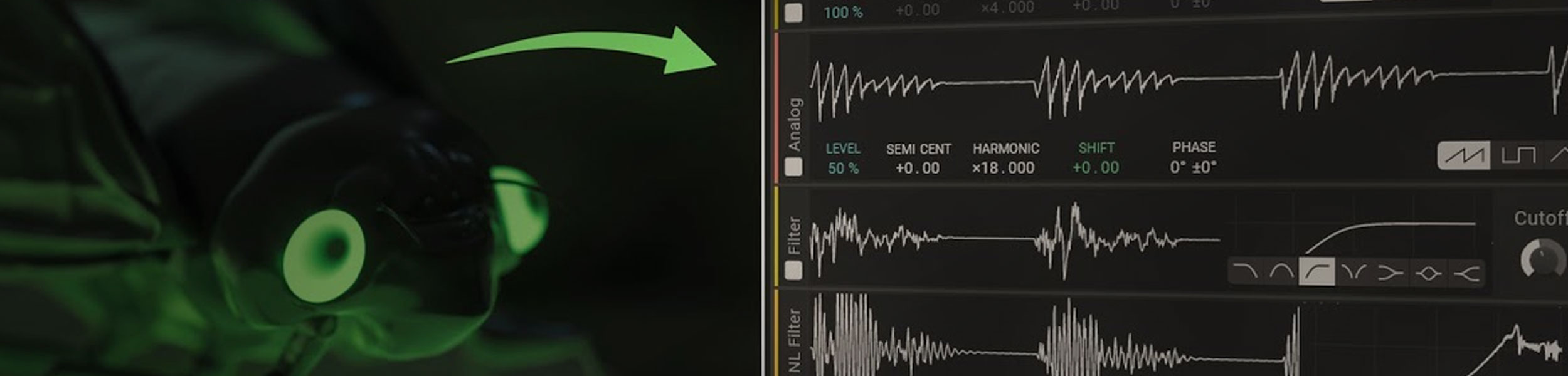
These are usually sounds with nonlinearities that change with time, such as the biphonation patterns present in various bird sounds, which may interact in unintuitive ways.
While the solutions for such challenges are unique to each sound, I arrive at them through iterations of re-analysis, online reading, and gathering insight from my peers.
Q. When you start a soundscape like this, where do you usually begin?
For both inspirational and technical reasons, I start with analysis.
Broadly speaking, I'm looking for patterns on both the sound and soundscape level. On the level of individual sounds and calls, I learn from spectrotemporal shapes and modulation patterns, which I replicate in Phase Plant as modulator curves. On the soundscape level, I try to understand social and ecological patterns.
Q. What is one good tip for making procedural sound design feel natural?
While I think that varying a sound with random modulation can be beneficial, my tip would be to correlate the modulation with what actually happens in the sound.
This could be done by using some feature of the sound, such as a call's amplitude or pulse rate, to influence the modulation rate or depth, or by creating feedback between the modulator and carrier signal, and so on.
Q. What is next for Amfivolia?
Amidst my current projects, the one most related to this conversation is my ongoing bird synthesis project, which will be accompanied by a video tutorial as usual.
Aside from that, I've been working on a lengthy, hibernal music composition for the past few months which I hope to release soon. Above all else, I'm most excited to create composition-centered videos to share with everyone.
Huge thanks to Amfi for taking the time to answer our questions and share a bit of how he approaches ecosystem-inspired sound design in Phase Plant.
If you want to explore more of Amfi's work, head over to Bandcamp, Patreon, and the YouTube channel.
If you want to go deeper, the videos below are proper deep dives into this kind of synthesis and how it is done.

If this particular corner of sonic chaos appeals to you, Phase Plant is $100 off and all Content Banks are 50% off from May 28th to June 12th.
This article is part of Phase Plant's 7th Anniversary, where we are talking to more Phase Plant Power Users about bass design, FM, MPE, game audio, cinematic work, wavetable design, and generative sound.