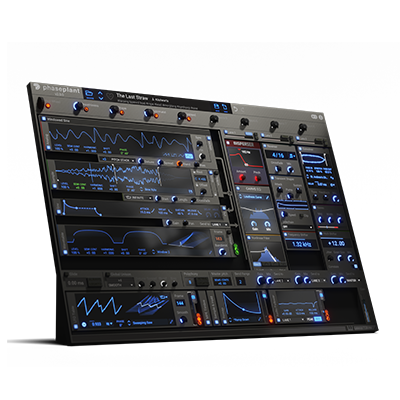
Phase Plant is not just a great sound design tool. It can also be a seriously expressive instrument, especially when you bring MPE into the picture.
Per-note control opens up a level of nuance that is hard to fake with regular automation, and it makes performance feel much more direct and physical.
That is also exactly the kind of thing we wanted to highlight during Phase Plant's 7th Anniversary.
Christian Laffitte felt like a very natural person to talk to here. He is another Phase Plant Power User, and his work with Expressive E has focused on making digital synths feel more tactile, reactive, and human.
We put seven questions to Christian Laffitte about MPE, expressive control, and building patches that feel good to play.
Q. To start us off, can you introduce yourself and tell our readers a little about your work?
Hi everyone! I'm a sound designer and electronic musician deeply fascinated by the intersection of technology and acoustic-like expressivity.
My work revolves around pushing the boundaries of software synthesizer presets to make them feel like living, organic, real instruments. Over the last few years, I've had the privilege of collaborating closely with Expressive E, creating content and presets that bridge the gap between complex digital synthesis and raw, tactile performance.
Whether I'm designing hyper-reactive patches or composing, my goal is always the same: to make electronic music feel deeply human.
Q. What does MPE add to a synth performance that regular MIDI usually does not?
In short: polyphonic freedom.
Traditional MIDI is global. If you apply pitch bend or modulation, it affects every single note you are holding simultaneously. It feels rigid, like playing a piano but wanting it to behave like a violin section.
MPE unlocks 3D control per note. Each finger becomes independent. You can strike a chord, bend just the third note, add pressure-induced vibrato to the root note, and change the timbre of the top note just by sliding your finger vertically.
It transforms the synthesizer from a triggering machine into an acoustic instrument where every note has its own unique DNA and emotional arc.
Q. What makes Phase Plant such a strong synth for expressive performance?
Phase Plant is an absolute masterpiece for MPE because of its modular workflow and limitless modulation matrix.
A lot of synths limit how many parameters you can map to expression. In Phase Plant, you can route the MPE input modulators - Timbre, Pressure, Glide, and Slide - to anything. Want pressure to subtly change the analog distortion drive while widening the stereo image of just that note? It takes two seconds to set up.
Its generators - wavetable, FM, sampler, analog - can be combined freely, meaning you can couple the organic transient of a sample with the expressive power of an FM carrier, all reacting perfectly to your touch.
Q. Is there a patch or moment in your Expressive E work that best shows what Phase Plant can do?
There is a patch I designed called Amber Reign for one of the Expressive E banks.
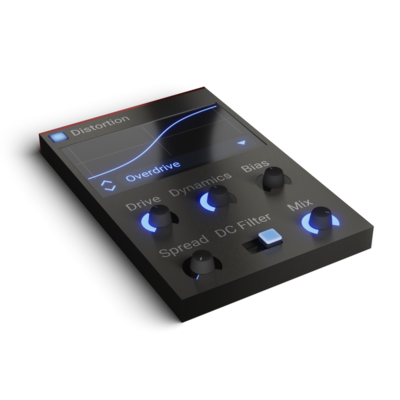
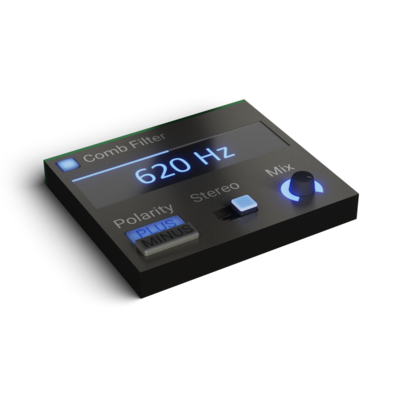
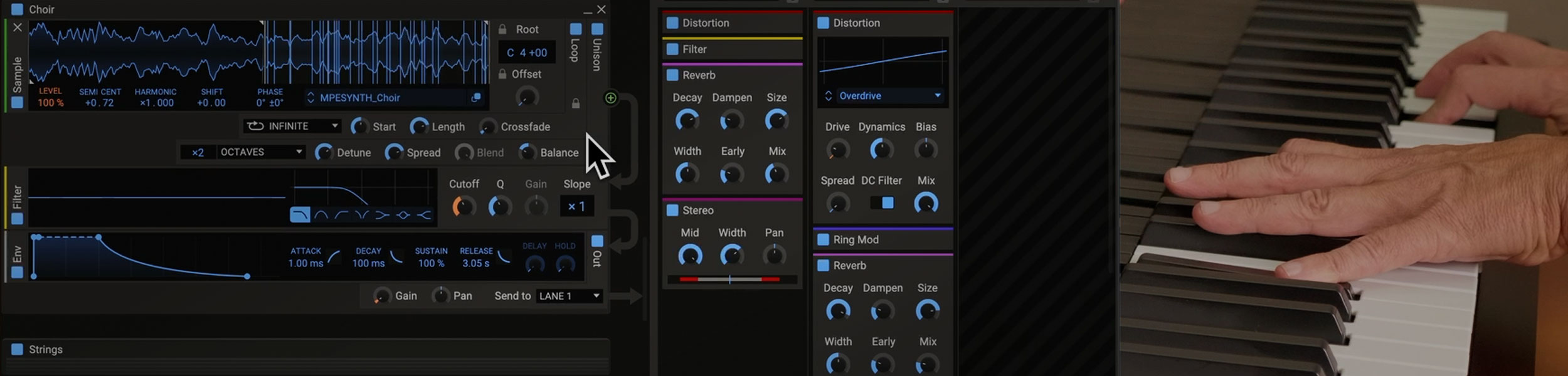
It uses Phase Plant's Sample Player routed through heavy ring modulation, distortion, and modulated comb filters. I designed it as a powerful cinematic preset that blurs the line between orchestral sampling and expressive performance.
In the lower range, I've integrated cymbals and timpani meticulously mapped to Strike for tactile dynamic control. By leveraging Pressure and MPE Timbre, I can intricately shape the evolution of the strings and violins, with a Pizzi mode on the mod wheel, and gain-stage the intensity to craft deeply impactful, human moments.
Q. When designing an MPE patch from scratch, where do you begin?
I always start with the tactile feeling before I even choose the synthesis type. I ask myself: "What story do I want my fingers to tell?"
First comes the core. I set up a basic initialized sound, whether that means synths or samples, and immediately map Pressure to the volume and a low-pass filter.
Then come the micro-movements. Once the tracking feels natural, I assign MPE Timbre and Pressure to something timbral, like wavetable position, FM depth, or effects.
Q. What advice would you give someone designing their first MPE-ready Phase Plant patch?
Keep it simple at first, and gain-stage your modulations.
When people discover MPE in Phase Plant, they often map everything to everything, and it ends up sounding like a chaotic, uncontrollable mess. Start with just Pressure mapped to gain and filter cutoff. Master that response curve first.
Use the Slew Limiter in Phase Plant to tweak how the synth responds to your touch. A linear curve rarely feels good. You usually want an exponential curve so that the sound opens up gently before hitting its peak.
In simple terms, the Slew Limiter in Phase Plant is a signal smoother. Its main job is to restrict how fast a modulation signal can change. If a signal, like an envelope or an LFO, jumps or drops instantly, the Slew Limiter forces it to slow down and take its time, rounding off those sharp digital corners.
Remember: good MPE design is about subtlety. A 2% pitch drift or a 5% increase in saturation can do a lot more for expressivity than a massive, sweeping effect.
Q. What are you personally exploring next in expressive synthesis?
Right now, I am deeply invested in combining samples and synth with MPE.
I want to simulate physical materials like wood, metal, and glass, and use controllers like the Osmose to excite these sampled materials in real time.
I'm also exploring how we can use MPE to control percussion and electronic sounds. Imagine not just changing the tone of a note with your finger pressure, but actually moving that specific timbre, sequence, or arp in performance.
Huge thanks to Christian for taking the time to answer our questions and share some of his thinking around MPE, touch, and expressive patch design in Phase Plant.
If you want to explore more of Christian's work, head over to MPESYNTH.COM, Instagram, and YouTube.
If you want to see these patches in action, the video below is a great preset demo with some useful insight into how Christian approaches this side of synthesis.

If it does, the anniversary timing works in your favor: Phase Plant is $100 off and all Content Banks are 50% off from May 28th to June 12th.
This article is part of Phase Plant's 7th Anniversary, where we are talking to more Phase Plant Power Users about bass design, FM, MPE, game audio, cinematic work, wavetable design, and generative sound.