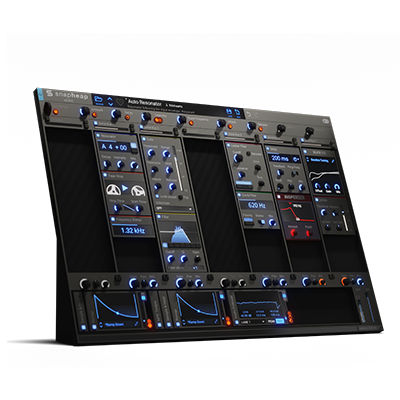
For Game Audio Week 2026, we challenged you to create a Snap Heap preset that could transform a voice for an imaginary game. We were looking for original ideas, useful macro controls, and the flexibility to make sounds that could find a place in a real project.
Thank you to everyone who entered. Several members of the Kilohearts team spent time exploring the presets with both the supplied recordings and other source material. The whole team also listened to the submitted demos and shared their feedback.
We were impressed by the quality across the contest, and choosing the winners was difficult. Alongside the winner and runners-up, we have included two honorable mentions. You can download all the submitted presets from the sidebar and explore them for yourself.
After plenty of listening, testing, and discussion, here are the results.
Winner: Luke Bannon
Preset: Cursette Tape
Luke's Cursette Tape is an exceptionally versatile preset built around three distinct styles: Monsterfy, Robotizer, and Spirit Box. More general controls such as Large/Small, Malfucntion, and Reverb Distance expand its range further. The mod wheel is used to control the amount of reverb.
The preset puts every macro to work and uses extensive modulation throughout. Luke uses every lane in Snap Heap, with some lanes containing more Snap Heap presets of their own. A lot of thought seems to have gone into making one patch capable of producing a wide range of results, making it a useful tool for many tasks in a real project.
Luke's demo uses all three contest recordings and moves between them to show the preset's range. Even then, Cursette Tape can do much more than the demo reveals, so it is well worth downloading and trying out for yourself.
Luke wins Kilohearts Ultimate and the SFX Pro 9000 Content Bank. Congratulations, Luke!
Runner-up: emilyavi
Preset: Robotica Standard
Robotica Standard was a very close runner-up. It makes full use of the macros and contains plenty of clever modulation, including a switcher built with remaps that lets you choose between five different voice models within a single preset.
Once you have selected a model, practical controls for the noise gate, compression, colour, de-essing, pitch shifting, and pitch variation help you shape it for the source and the character. Those pitch controls are particularly useful for suggesting monsters and characters of different sizes.
The preset also contains nested Snap Heap and Multipass patches. If you own both hosts, those patches are useful tools in their own right and can be pulled out for use elsewhere. Emily supplied five audio demos showing the range of Robotica Standard, along with some lovely poetry that was much appreciated by the team.
Runner-up: Thiago Schiefer
Presets: Dynamic Pitch Dropping, Glitch Interference, and Walkie-Talkie with Distance Attenuation
Thiago submitted a set of focused, practical patches. Walkie-Talkie with Distance Attenuation turns a voice into radio communication and includes distance control for placing it in a scene. Dynamic Pitch Dropping creates layered monster voices with variable pitch and harmony, ideal for monsters, aliens, gods, and other larger-than-life characters. Glitch Interference takes a more destructive approach, combining effects including bitcrushing, gating, Tape Stop, and randomisation.
Each preset has one or two macros for controlling the strength and variation of its effect. His demos pair each patch with the source recording it suits best.
Both runners-up win a $60 USD coupon for a perpetual license or Content Bank in the Kilohearts store, including Ultimate upgrades.
Honorable mentions
Two more entries came very close to winning and deserve a mention.
Louis David
Preset: Spatializer
Spatializer is a powerful utility for simulating the position and movement of a sound source in 3D space. Louis combines Snap Heap processing in both series and parallel, with extensive modulation behind a complete set of macros for 360-degree rotational position, distance, isolation, altitude, Doppler intensity, and source-size multiplication. Room tone and mix controls help place the result within a convincing environment.
The preset also uses nested Snap Heap patches, which is a great demonstration of how tools you have already made can be combined into larger systems with new controls and new applications. Spatializer could be useful not only for game audio, but also for film, television, and other work involving sound for picture.
Louis's demo was particularly memorable. Rather than processing a single voice in isolation, he created a complete scene using the contest samples alongside his own recordings. Sounds arrive from different directions, altitudes, distances, and moving positions, clearly demonstrating what Spatializer can do in context.
Sigve
Preset: Evil Chord
Evil Chord is a particularly strong example of a familiar voice-design technique: layering a vocal with pitch-shifted versions of itself to create a larger and more sinister character. Sigve combines that effect with practical compression and EQ, making it easier to reach a controlled, usable tone without additional processing.
Its five macros shape the amount of the chord and multivoice layering alongside compression and EQ, unusual reverb, and distortion. Together, they provide plenty of scope for designing monsters, aliens, gods, and other imposing characters. The submitted demo shows it off with a polished sound that would not be out of place in a real game.
Thanks for entering
Congratulations to Luke, emilyavi, and Thiago, and thanks again to everyone who took part. We loved hearing what you made with Snap Heap and seeing the different approaches you brought to the challenge.
If you missed it, there is plenty more to explore from Game Audio Week 2026, including articles and ideas for sound design. We look forward to another Game Audio Week next year!